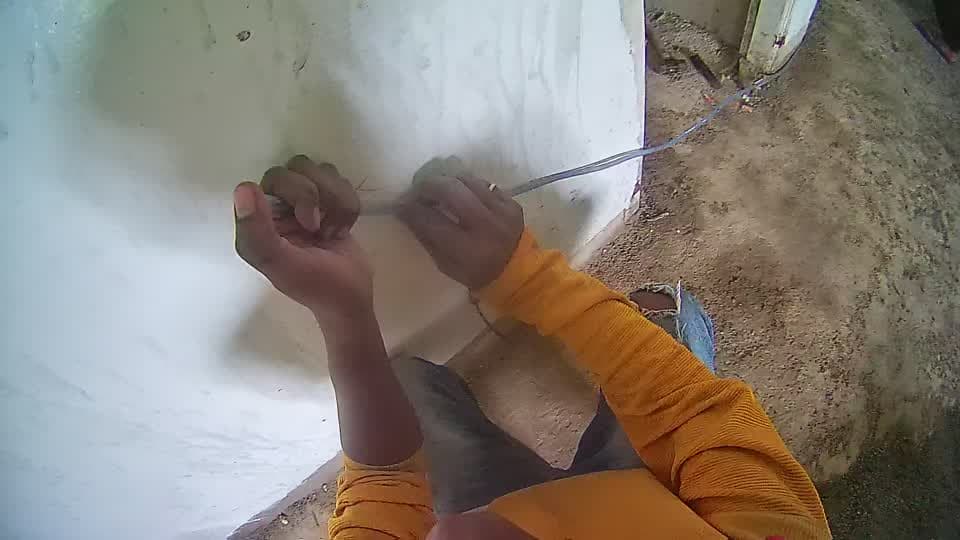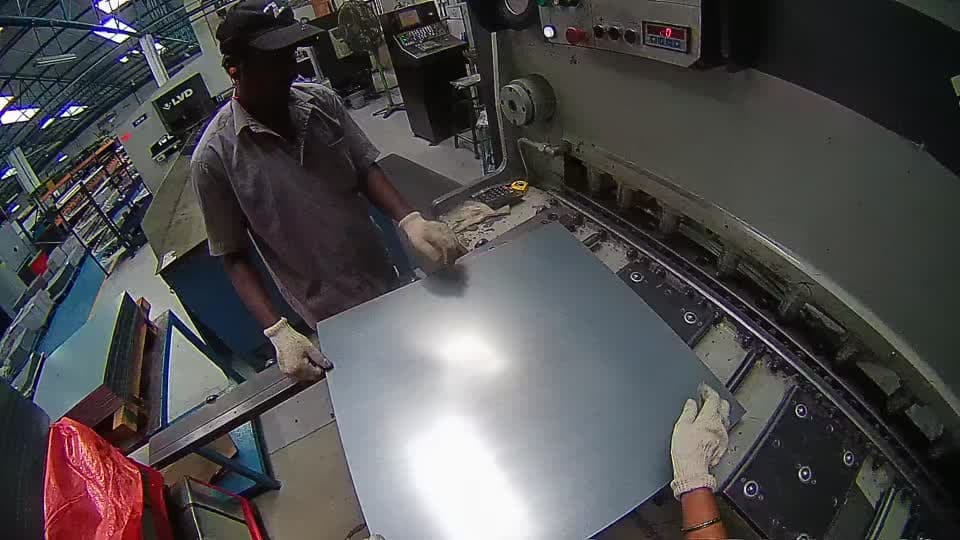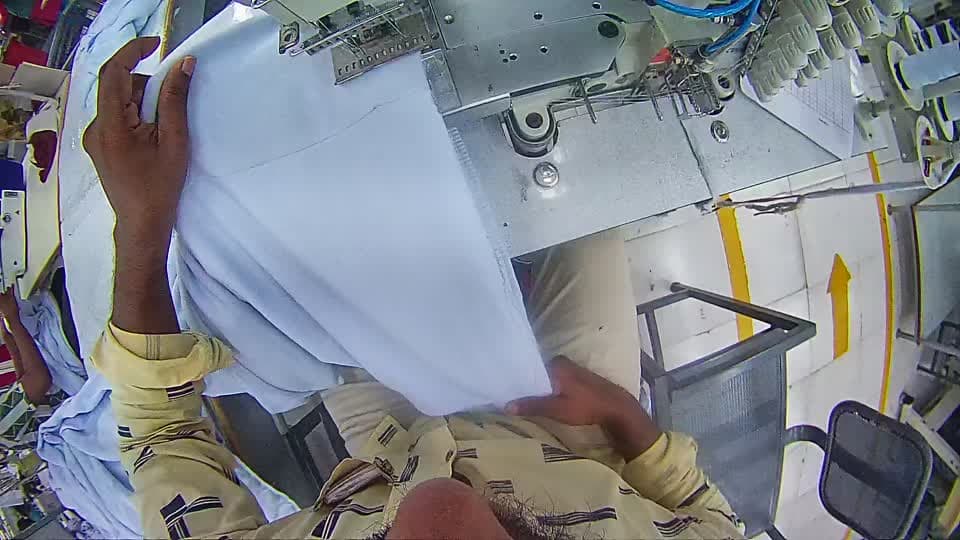
Point one camera at a person folding fabric at a sewing station and strap another to their head, and you get two very different recordings of the same minute of work. The first shows the person, the station and the room. The second shows two hands, the fabric and the machine, moving with every turn of the head. Neither is better in general. Each is better at teaching a model something specific.
This article compares egocentric (first-person) and third-person (exocentric) video for AI training, so you can choose the right viewpoint — or the right mix — for a project.
Definitions
Egocentric video is recorded by a camera worn by the person performing the activity, usually on the head, chest or glasses. Third-person video is recorded by a camera that is not attached to the actor: fixed on a tripod or wall, handheld by someone else, or mounted on a moving platform. Third-person footage from a single standard camera is often called mono-RGB.
What each viewpoint sees
Egocentric
- Hands and manipulated objects are large, central and usually unoccluded by the body.
- The view follows attention, so the next target often appears before the hand moves.
- The wearer’s body is mostly invisible; posture and full-body motion must be inferred from IMU data or not at all.
- Camera motion is constant and sometimes fast, so footage can blur and stabilisation matters.
- Wide-angle lenses are common, which introduces distortion near frame edges.
Third-person
- The full body, posture and spatial relationship to the environment are visible.
- Fixed cameras produce stable footage, which is easier to annotate and track over time.
- Hands are smaller and are often hidden by the torso, the object itself or other people.
- Multiple people and their interactions can be observed at once.
- A single view lacks depth, but several calibrated views can reconstruct 3D motion.
How the choice affects model training
Manipulation and grasping
For learning how hands interact with objects — grasp type, contact points, in-hand adjustments — egocentric video is usually the stronger source. The detail is simply present in the pixels. It also matches the viewpoint of robots with head or wrist cameras, which reduces the domain gap at deployment.
Activity recognition and safety monitoring
For recognising what people are doing in a space — whether a worker has entered a restricted zone, whether a patient has fallen, how a line operator moves between stations — third-person footage is usually better. These systems will themselves be deployed on fixed cameras, so training on that viewpoint is the natural fit.
Pose estimation
Full-body pose is far easier to label from a third-person view. Hand pose is far easier from a first-person view. Projects that need both often pair a head-mounted camera with one or more fixed cameras, synchronised in time.
Annotation differences
Annotating egocentric video has its own challenges. Objects enter and leave the frame quickly as the head moves, so object tracks are shorter and identity must be re-established often. Motion blur can hide the exact frame of contact, so temporal boundary rules need to say how to handle it. Third-person video makes tracking easier but makes hand-level labels harder, because the hands are small and frequently occluded — a problem discussed in The occlusion problem in video annotation.
Combining viewpoints
Paired ego-exo recordings — the same activity captured simultaneously from a worn camera and one or more external cameras — are increasingly common in research. They let a model learn the correspondence between what the actor sees and what an observer sees. That correspondence is useful for transferring skills from observation to action, and for systems that must reason about a person from the outside while assisting them.
The cost is synchronisation and calibration. Every camera must share a time base, and if 3D reconstruction is needed, external cameras must be calibrated relative to each other.
How to choose
- Start from the deployed sensor. If the model will run on a head or wrist camera, collect egocentric. If it will run on a ceiling camera, collect third-person.
- Identify the critical detail. Fingers and contact favour egocentric; posture and spatial layout favour third-person.
- Consider annotation cost for the labels you need, not just capture cost.
- If both matter, budget for paired capture and synchronisation rather than collecting two unrelated datasets.
Conclusion
Egocentric and third-person video are complementary rather than competing. First-person footage carries the detail of interaction; third-person footage carries context, posture and the relationship between people and space. The right choice follows from where the model will be deployed and which detail it cannot do without.
Mvaak collects egocentric video for robotics and Physical AI and annotates video data for computer vision. See Egocentric Video Data and Video annotation, or read What Is Egocentric Data and Why Does Physical AI Need It?.
Written by Mvaak — AI Data Services.